
Moon (Chandra) in Vedic Astrology
The queen of the planetary cabinet and ruler of the mind — the Moon governs emotions, mental peace, mother, and the ebb and flow of fortune in Vedic astrology.
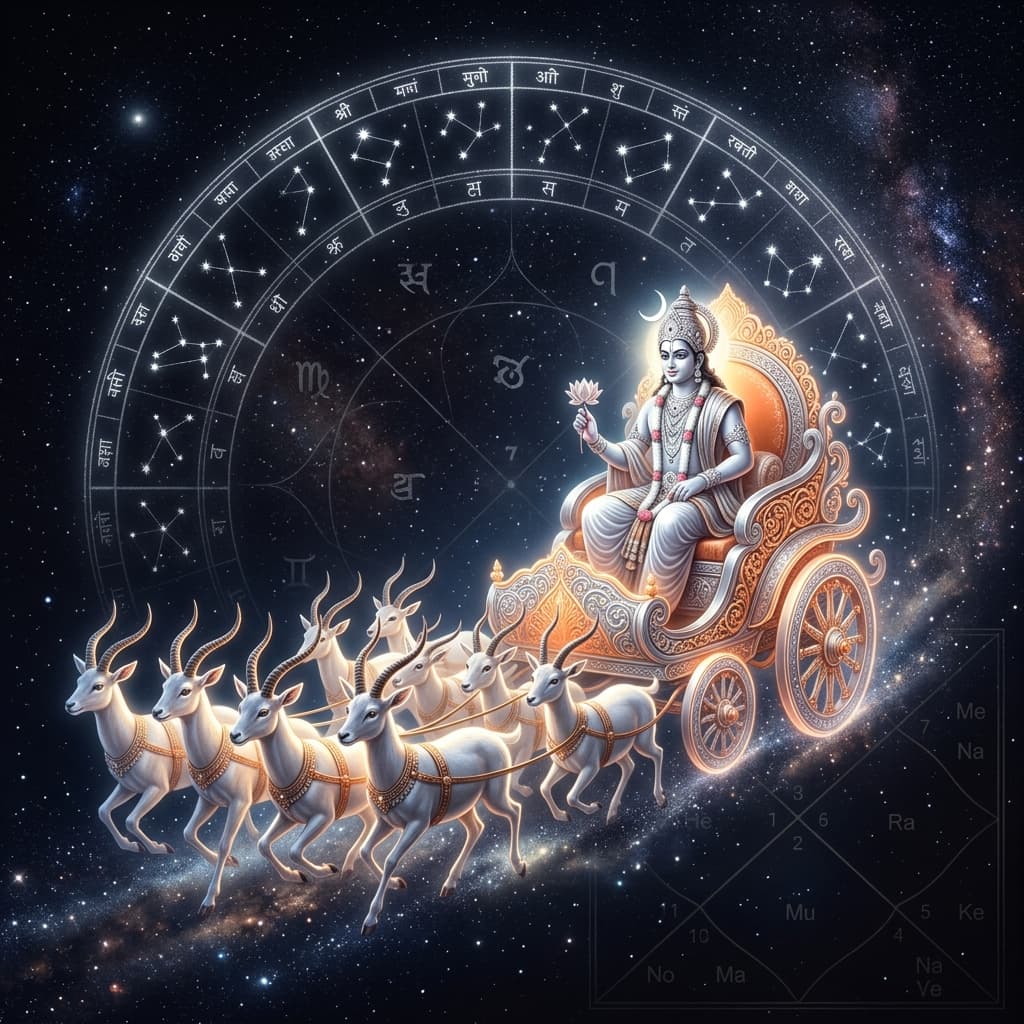
Overview and Significance
If the Sun represents the soul, the Moon (Chandra) represents the mind (Manas). In Vedic astrology, the Moon holds an extraordinarily elevated position — arguably more important than the Sun for daily life experience. While the soul is the eternal essence, it is the mind that processes every moment of waking life. The Moon determines how you perceive reality, how you react emotionally, and how content or disturbed you feel on a day-to-day basis.
The entire Vimshottari Dasha system — the primary predictive tool in Vedic astrology — is calculated from the Moon’s Nakshatra (lunar mansion) at birth. The Moon sign (Rashi) is often considered more important than the Sun sign for personality assessment, and the Moon’s condition is the first thing an experienced astrologer examines when evaluating a chart. A person with a strong, well-placed Moon experiences emotional stability, popularity, mental sharpness, and a nurturing disposition. A weak or afflicted Moon can lead to anxiety, depression, emotional volatility, and a perpetual sense of dissatisfaction.
Chandra is a natural benefic when waxing (Shukla Paksha) and tends toward malefic qualities when waning (Krishna Paksha). This waxing and waning nature mirrors the Moon’s core symbolism — it is the planet of change, cycles, and fluctuation. Nothing in the chart is as sensitive to transits and progressions as the Moon, making it the key to understanding the rhythm of life’s ups and downs.
Key Attributes
Chandra, Soma
Cancer (Karka)
Taurus (3°)
Scorpio (3°)
Water (Jala)
Pearl (Moti)
Monday (Somvar)
2
White / Silver
North-West
Silver (Chandi)
Monsoon (Varsha)
What the Moon Represents
Mind and Emotions: The Moon is the primary karaka for the mind. It governs emotional intelligence, intuition, mood, memory, and the capacity for empathy. The Moon’s strength determines whether a person possesses a calm, receptive mind or one that is restless, anxious, and prone to overthinking. In Vedic psychology, mental wellness begins with a strong Moon.
Mother and Nurturing: The Moon represents the mother in a birth chart. Its condition indicates the relationship with the mother, the mother’s health and well-being, and the native’s own nurturing instincts. A well-placed Moon often indicates a loving, supportive maternal relationship and a strong inclination toward caregiving professions.
Public Life and Popularity: The Moon governs the public, masses, and collective consciousness. Politicians, public figures, and people in hospitality or service industries need a strong Moon to connect with large groups of people. The Moon determines how the public perceives and receives you.
Fertility and Nourishment: The Moon rules bodily fluids, fertility, the stomach, breasts, and the lymphatic system. It governs nourishment in all its forms — food, emotional sustenance, and the capacity to nurture growth in others. Agricultural cycles, tidal patterns, and biological rhythms all fall under the Moon’s domain.
Travel and Change: Due to its fast orbital speed (it changes signs every 2.25 days), the Moon is the planet of movement, travel, and change. Frequent short travels, changes in residence, and fluctuations in fortune are all connected to the Moon’s influence in the chart.
Effects When Strong vs Weak
A Strong Moon
A waxing Moon exalted in Taurus, placed in Cancer (own sign), in a Kendra house, or receiving Jupiter’s aspect creates a profoundly positive life experience. The native enjoys emotional stability, a peaceful mind, excellent memory, and natural popularity. Relationships with the mother and women in general are harmonious. There is an instinctive ability to read people and situations, making the person successful in public-facing roles. Creativity flows naturally, imagination is vivid, and the individual possesses a magnetic charm that draws others to them. Financial fortune tends to fluctuate but trends upward, and there is a strong connection to home, family, and cultural roots.
A Weak or Afflicted Moon
A waning Moon debilitated in Scorpio, conjunct Rahu or Ketu, aspected by Saturn or Mars without benefic support, or placed in dusthana houses (6th, 8th, 12th) creates significant mental and emotional challenges. The native may experience chronic anxiety, depression, mood swings, insomnia, or a persistent sense of emotional emptiness. The relationship with the mother may be troubled or distant. There can be digestive issues, water retention, and hormonal imbalances. Decision-making becomes difficult as the mind wavers between options. In severe cases, a heavily afflicted Moon can indicate psychological disorders that require professional support alongside astrological remedies.
Moon in the 12 Houses
1st House
Self & Identity
Moon in 1st House
Read full analysis →
2nd House
Wealth & Family
Moon in 2nd House
Read full analysis →
3rd House
Courage & Siblings
Moon in 3rd House
Read full analysis →
4th House
Home & Mother
Moon in 4th House
Read full analysis →
5th House
Children & Romance
Moon in 5th House
Read full analysis →
6th House
Health & Enemies
Moon in 6th House
Read full analysis →
7th House
Marriage & Partners
Moon in 7th House
Read full analysis →
8th House
Transformation
Moon in 8th House
Read full analysis →
9th House
Fortune & Dharma
Moon in 9th House
Read full analysis →
10th House
Career & Status
Moon in 10th House
Read full analysis →
11th House
Gains & Aspirations
Moon in 11th House
Read full analysis →
12th House
Losses & Liberation
Moon in 12th House
Read full analysis →
1st House (Lagna)
Attractive appearance, emotional nature, changeable disposition. Popular and well-liked. Strong connection to the mother. The personality is sensitive, receptive, and often artistic.
2nd House (Dhana)
Wealth that fluctuates, pleasant speech, love of good food. Strong family bonds and a beautiful face. May accumulate wealth through public-facing roles or the food industry.
3rd House (Sahaja)
Creative communication skills, restless mind, many short journeys. Good relationship with siblings, especially sisters. Artistic talent in writing, music, or media.
4th House (Sukha)
Excellent placement giving domestic happiness, strong bond with mother, property ownership, and inner peace. Love for home comforts, vehicles, and education. The mind finds contentment.
5th House (Putra)
Highly creative and intelligent, with strong intuitive abilities. Good fortune with children, romantic nature, and success in speculative ventures. Drawn to artistic and entertainment fields.
6th House (Ripu)
Emotional sensitivity to enemies and competition. May experience digestive issues or anxiety. However, service-oriented and can excel in healthcare, counselling, or social work.
7th House (Kalatra)
Attractive and nurturing spouse. Marriage brings emotional fulfilment. Strong public partnerships. Business success through female associations. May marry someone from a different background.
8th House (Randhra)
Emotionally intense, secretive nature. Psychic abilities and interest in the occult. Emotional upheavals and transformative experiences. The mother may face health challenges. Deep intuition.
9th House (Dharma)
Spiritual inclinations, religious mother, and good fortune through travel. The mind is philosophical and drawn to higher learning. Pilgrimage and connection to spiritual traditions.
10th House (Karma)
Public fame and recognition, career in public-facing roles. Success in politics, hospitality, nursing, or any field serving the masses. The career involves frequent changes and travel.
11th House (Labha)
Fulfilment of desires, large social circle, and gains through women and the public. Friends are emotionally supportive. Income comes through multiple fluctuating sources.
12th House (Vyaya)
Vivid dream life, spiritual depth, and preference for solitude. May live in foreign lands. Expenses on comforts and spiritual pursuits. Sleep may be disturbed if afflicted.
Important Yogas Involving the Moon
- Gajakesari Yoga: Formed when Jupiter is in a Kendra (1st, 4th, 7th, or 10th) from the Moon. This is one of the most celebrated yogas in Vedic astrology, bestowing wisdom, wealth, fame, and lasting reputation. The name means “elephant-lion” — a person of great strength and dignity.
- Chandra-Mangal Yoga: Moon conjunct Mars creates wealth through enterprise, real estate, or the food industry. The person is emotionally passionate but may also be temperamental. Excellent for business acumen and financial gains.
- Sunaphaa Yoga: Any planet (except the Sun) in the 2nd house from the Moon gives self-made wealth, intelligence, and a good reputation. The specific results depend on which planet creates the yoga.
- Anaphaa Yoga: Any planet (except the Sun) in the 12th house from the Moon gives charisma, physical beauty, and a generous disposition. It enhances the Moon’s positive qualities and creates a magnetic personality.
- Durudhara Yoga: Planets on both sides of the Moon (2nd and 12th houses from it) create a balanced, prosperous, and well-supported life. This yoga is similar to Ubhayachari Yoga for the Sun but operates on the emotional and mental plane.
- Kemadruma Yoga: When no planet occupies the 2nd or 12th house from the Moon (and no planet conjoins it), it creates isolation, poverty, and emotional suffering. However, this yoga has many cancellation conditions — any planet in a Kendra from the Moon or Lagna can cancel it.
Vedic Remedies for the Moon
Gemstone: Pearl (Moti)
A natural, untreated Pearl set in silver should be worn on the little finger of the right hand on a Monday during Shukla Paksha. The Pearl strengthens the Moon’s calming, nurturing energy and is particularly beneficial for emotional stability and mental peace. It should weigh at least 4 carats for effectiveness.
Mantra
The Chandra Beej Mantra — “Om Shraam Shreem Shraum Sah Chandraya Namah” — should be chanted 11,000 times during the Moon’s Hora on Mondays, or 108 times daily. Reciting the Chandra Kavacham or the Chandra Ashtottara Shatanamavali (108 names of the Moon) is also highly effective.
Deity: Lord Shiva and Goddess Parvati
Lord Shiva wears the crescent Moon on his head (Chandrashekhara), making Shiva worship one of the most powerful remedies for Moon afflictions. Offering water and milk on a Shivling on Mondays, observing Somvar Vrat (Monday fast), and chanting the Maha Mrityunjaya Mantra are all recommended. Worshipping Goddess Parvati or any form of the Divine Mother also strengthens the Moon.
Charity (Daan)
Donating white items on Mondays — rice, milk, white cloth, silver, curd, or sugar — strengthens the Moon. Feeding white cows or donating to women’s welfare organisations is particularly effective. The charity should be offered with compassion and gratitude.
Lifestyle Practices
Drinking water from a silver glass, keeping a silver item on your person, maintaining a regular sleep schedule, meditating before bed, and spending time near water bodies all help strengthen a weak Moon. Maintaining a respectful, loving relationship with your mother and women in general is also critical.
Understand Your Moon’s Influence
Your Moon sign shapes your emotions, relationships, and mental well-being. Get a comprehensive analysis of the Moon’s placement, Nakshatra, and Dasha timing in your chart.
Get Your Life Guidance ReportFrequently Asked Questions About the Moon in Vedic Astrology
What are the effects of the Moon in Vedic astrology?
The Moon (Chandra) represents the mind, emotions, mother, and mental well-being. It is arguably the most important planet for daily life, governing how you perceive and react to reality. The entire Vimshottari Dasha system is calculated from the Moon’s Nakshatra. A strong Moon gives emotional stability, popularity, and intuition. A weak Moon creates anxiety, depression, and emotional volatility.
What happens when the Moon is weak or afflicted?
A weak Moon (debilitated in Scorpio, conjunct Rahu or Ketu, or aspected by Saturn/Mars without benefic support) causes chronic anxiety, depression, insomnia, troubled relationship with the mother, and digestive issues. Remedies include wearing a Pearl in silver on Monday, chanting the Chandra Beej Mantra, worshipping Lord Shiva on Mondays, and donating white items.
Which house is best for the Moon?
The Moon gives excellent results in the 4th house (domestic happiness, inner peace), 1st house (charming personality), 5th house (creativity and intuition), and 2nd house (wealth). The Moon is most powerful in Cancer (own sign) or exalted in Taurus. It is most challenged in the 8th house and when debilitated in Scorpio. The 4th house is particularly natural for the Moon.
What is Gajakesari Yoga with the Moon?
Gajakesari Yoga forms when Jupiter is in a Kendra (1st, 4th, 7th, or 10th house) from the Moon. This celebrated yoga bestows wisdom, wealth, lasting fame, and dignity. The name means “elephant-lion.” It is most powerful when both Jupiter and Moon are in strong, friendly signs. Active results come during Jupiter or Moon Mahadasha periods.
How does Sade Sati relate to the Moon?
Sade Sati is Saturn’s 7.5-year transit through the 12th, 1st, and 2nd houses from the natal Moon. The Moon’s natal strength determines how intensely Sade Sati is experienced. A strong Moon with benefic aspects can turn Sade Sati into a period of profound growth. Remedies include Saturn and Hanuman worship on Saturdays, chanting Shani Beej Mantra, and strengthening the Moon itself.
What are the remedies for a weak Moon?
Key remedies: (1) Wear a natural Pearl in silver on the little finger on Monday, (2) Chant “Om Shraam Shreem Shraum Sah Chandraya Namah” 108 times daily, (3) Offer milk on a Shivling on Mondays and observe Somvar Vrat, (4) Donate white rice, milk, or silver on Mondays, (5) Drink from a silver glass, meditate before bed, and spend time near water bodies.
Related Topics
Moon in All 12 Houses
Explore the effects of Moon (Chandra) placed in each of the 12 houses of the Vedic birth chart.
Frequently Asked Questions
What does the Moon represent in Vedic astrology?
The Moon (Chandra) represents the mind, emotions, mother, public, nourishment, and domestic life. It is the most important planet in Vedic astrology for understanding a person's emotional nature and mental patterns. The Moon sign (Rashi) and Nakshatra at birth determine your Dasha sequence and are central to compatibility analysis.
Which house is best for the Moon in Vedic astrology?
The Moon is strongest in the 4th house (its natural home — domestic happiness and emotional peace) and in the 1st house (vivid personality and strong intuition). It is exalted at 3° Taurus. The Moon does well in the 2nd, 5th, and 7th houses. It is debilitated in Scorpio and most challenged in the 8th and 12th houses.
What is Gaja Kesari Yoga with the Moon?
Gaja Kesari Yoga forms when Jupiter occupies a Kendra (1st, 4th, 7th, or 10th house) from the Moon in the birth chart. It bestows wisdom, eloquence, fame, and prosperity — one of the most auspicious yogas in Vedic astrology. The effect is strongest when both the Moon and Jupiter are strong and well-placed.
What are remedies for a weak or afflicted Moon?
Key remedies include: wearing a natural Pearl (Moti) in silver on the little finger on Monday, chanting the Chandra Beej Mantra 'Om Shraam Shreem Shraum Sah Chandraya Namaha' 108 times daily, worshipping Lord Shiva on Mondays, offering white flowers and milk to Shiva, and fasting on Mondays. Meditating on the full Moon and spending time near water bodies also strengthens the Moon.
