
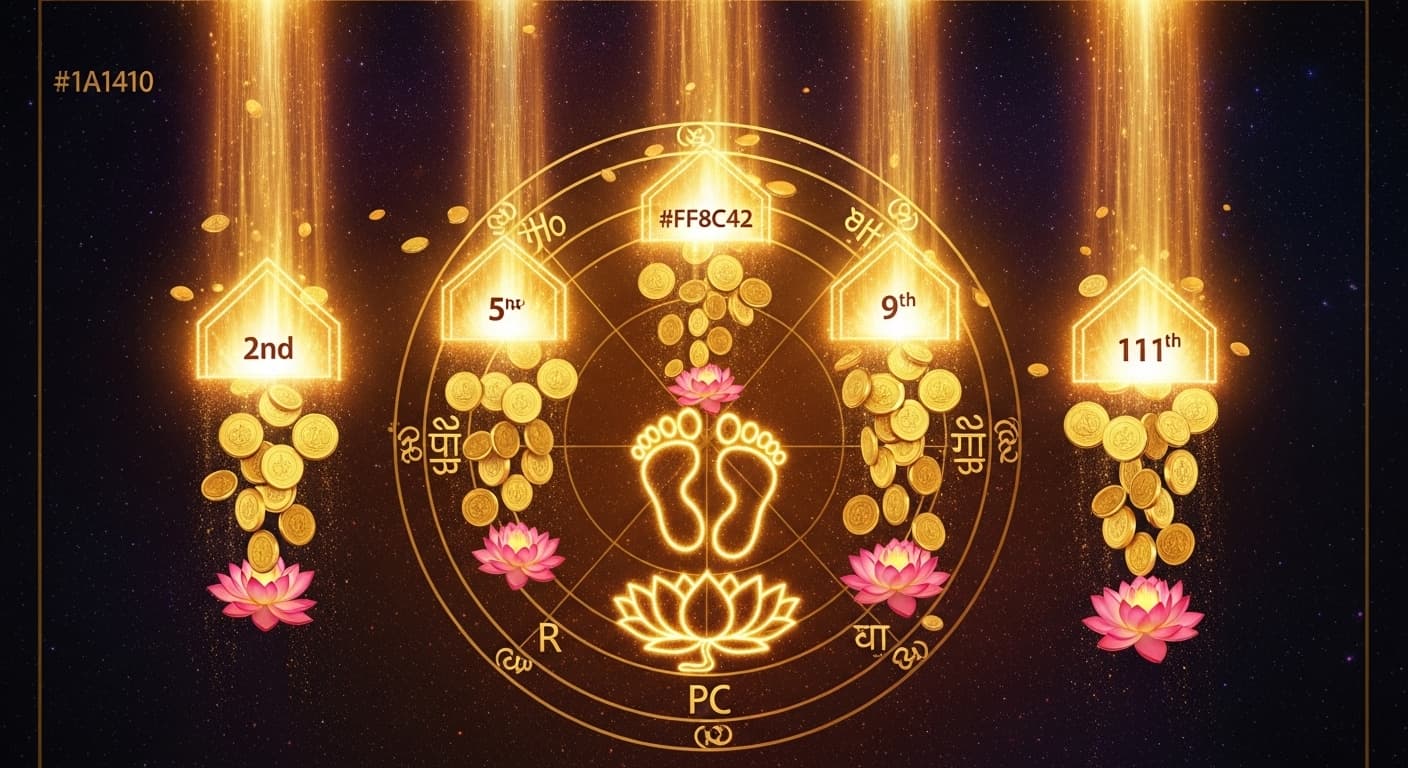
In Vedic astrology, the blueprint for your entire life is encoded in the birth chart — including your financial destiny. Among the most sought-after insights in Jyotish Shastra are the wealth-generating planetary combinations known as Dhana Yogas. These yogas reveal whether a person is destined for extraordinary prosperity, moderate comfort, or financial struggle, and critically, when that wealth is likely to manifest. Understanding Dhana Yoga is essential for anyone who wants to decode the financial promises hidden within their Kundli.
What is Dhana Yoga?
The word “Dhana” comes from Sanskrit and directly translates to “wealth” or “riches.” In the context of Vedic astrology, a “Yoga” is a specific combination or alignment of planets that produces a defined result in the native’s life. When we combine these two concepts, Dhana Yoga refers to any planetary configuration in a birth chart that has the power to generate wealth, financial abundance, or material prosperity.
Dhana Yogas form when the lords of specific wealth-related houses come into relationship with one another — through conjunction (occupying the same sign), mutual aspect, exchange of signs (Parivartana), or placement in each other’s houses. The most important houses for wealth formation are the 1st (self), 2nd (accumulated wealth), 5th (speculative gains and past-life merit), 9th (fortune and divine grace), and 11th (income and gains). When the lords of these houses interact favourably and are free from affliction by malefic planets like Saturn, Rahu, or Ketu, powerful Dhana Yogas emerge.
It is important to understand that the mere presence of a Dhana Yoga does not guarantee instant wealth. The strength of the planets involved (assessed through Shadbala), their dignity (own sign, exaltation, or debilitation), the house they occupy, and the current Dasha (planetary period) all determine whether — and when — the yoga will deliver its promise. A Dhana Yoga formed by strong, well-placed planets in a clean chart can elevate a person to extraordinary financial heights, while the same combination formed by weak or afflicted planets may produce only modest results.
Key Wealth-Generating Yogas in Vedic Astrology
Classical Vedic texts describe dozens of wealth yogas, but the following are the most significant and commonly analysed ones. Each carries a distinct mechanism for generating prosperity.
1. Dhana Yoga (Classic Formation)
The classic Dhana Yoga forms when the lords of the 2nd house (accumulated wealth and family resources) and the 11th house (gains, income, and fulfilment of desires) are in conjunction, mutual aspect, or exchange of signs. The 2nd house represents what you accumulate and hold, while the 11th house represents what flows in — salary, profits, and windfalls. When these two lords connect, the channels of earning and saving align, creating a natural flow of wealth into the native’s life.
For example, if you have a Taurus ascendant, Mercury (lord of the 2nd house, Gemini) and Jupiter (lord of the 11th house, Pisces) forming a conjunction in a Kendra or Trikona house would constitute a potent Dhana Yoga. The involvement of the 1st, 5th, or 9th house lords further amplifies the yoga’s power.
2. Lakshmi Yoga
Named after the Hindu goddess of wealth and prosperity, Lakshmi Yoga is one of the most auspicious combinations in Vedic astrology. It forms when Venus — the natural significator (karaka) of luxury, comfort, and material enjoyment — is placed in its own sign (Taurus or Libra) or exaltation sign (Pisces) in a Kendra house (1st, 4th, 7th, or 10th), and the lord of the 9th house (house of fortune) is strong and well-placed.
Natives with Lakshmi Yoga often enjoy wealth that comes with elegance and refinement. They tend to accumulate luxury assets — beautiful homes, vehicles, jewellery, and artistic possessions. The wealth feels effortless, almost as if fortune naturally gravitates toward them. This yoga is especially powerful for Taurus and Libra ascendants, where Venus also serves as the Lagna lord.
3. Raja Yoga
While Raja Yoga (“Royal Combination”) is primarily associated with power, status, and authority, it almost always brings significant wealth as a byproduct. Raja Yoga forms when the lord of a Kendra house (1st, 4th, 7th, or 10th — representing action and visibility) and the lord of a Trikona house (1st, 5th, or 9th — representing merit and fortune) are conjunct, in mutual aspect, or exchange signs.
The logic behind Raja Yoga is profound: Kendra houses give the power to act and achieve, while Trikona houses provide the fortune and past-life merit (Purva Punya) to succeed. When these forces combine, the native rises to positions of influence that naturally command wealth. CEOs, political leaders, and business magnates frequently have strong Raja Yogas in their charts. The wealth from Raja Yoga tends to be earned through position, authority, and career achievement rather than passive inheritance.
4. Gajakesari Yoga
Gajakesari Yoga is formed when Jupiter (Guru) is in a Kendra position (1st, 4th, 7th, or 10th house) from the Moon. The name itself reveals its promise: “Gaja” means elephant and “Kesari” means lion — the native commands the majesty and strength of both. This yoga bestows wisdom, reputation, and lasting wealth.
Jupiter is the greatest natural benefic in Vedic astrology, and the Moon represents the mind and emotional well-being. When these two form a strong angular relationship, the native possesses both the intellectual capacity to generate wealth and the emotional stability to sustain it. Gajakesari Yoga is particularly powerful when Jupiter is in its own sign (Sagittarius or Pisces) or exaltation (Cancer), and the Moon is waxing (Shukla Paksha). This yoga is found in the charts of many scholars, spiritual leaders, and financially successful professionals who build enduring legacies.
5. Chandra-Mangal Yoga
Chandra-Mangal Yoga forms when the Moon and Mars are conjunct in the same house. The Moon represents resources, nourishment, and public engagement, while Mars represents energy, ambition, courage, and the drive to acquire. When these two planets combine their energies, the native possesses an aggressive, action-oriented approach toward wealth creation.
People with Chandra-Mangal Yoga are often self-made and earn wealth through sheer effort, entrepreneurship, real estate, or industries related to Mars (engineering, military, surgery, sports). The wealth comes from active pursuit rather than passive fortune. This yoga is most effective when the conjunction occurs in wealth houses (2nd, 5th, 9th, or 11th) and both planets are in good dignity. If the conjunction occurs in signs where either planet is debilitated, the yoga’s wealth-giving potential is diminished, and the native may experience financial volatility.
6. Adhi Yoga
Adhi Yoga is a powerful yet often overlooked wealth yoga. It forms when natural benefic planets — Jupiter, Venus, and Mercury — occupy the 6th, 7th, and 8th houses counted from the Moon. This yoga indicates a person who will overcome competition (6th house), form valuable partnerships (7th house), and benefit from unexpected or hidden sources of wealth (8th house).
The more benefics involved, the stronger the yoga. When all three benefics participate, the native is said to attain the status of a king or leader — commanding resources, influence, and widespread respect. Adhi Yoga is particularly interesting because it operates from the Moon chart (Chandra Kundli), making it relevant even in charts where the Lagna chart may not show obvious wealth indicators. Natives with Adhi Yoga often find that their wealth grows through a combination of competitive advantage, strategic alliances, and fortunate circumstances that seem to appear exactly when needed.
Houses That Govern Wealth in the Birth Chart
Understanding which houses control wealth is fundamental to interpreting Dhana Yogas correctly. In Vedic astrology, four houses are directly connected to financial matters, and the strength of their lords and occupants determines the overall wealth potential of the chart.
2nd House — Accumulated Wealth (Dhana Bhava)
The 2nd house is the primary house of wealth. It governs accumulated savings, family resources, bank balance, fixed deposits, precious metals, and all forms of stored value. A strong 2nd house lord placed in a Kendra or Trikona, aspected by benefics, indicates a person who naturally accumulates and preserves wealth. The 2nd house also rules speech and family lineage, so wealth from inheritance or family business is also seen here.
5th House — Speculative Gains (Poorva Punya Bhava)
The 5th house governs speculation, investments, stock markets, creative earnings, and past-life merit. Wealth indicated by the 5th house often comes from intelligence, creativity, or risk-taking. A strong 5th house lord connecting with the 2nd or 11th lord can indicate success in stock trading, creative industries, or entrepreneurial ventures. It also represents the Purva Punya — merit earned from past lives that manifests as good fortune in this one.
9th House — Fortune and Divine Grace (Bhagya Bhava)
The 9th house is the house of luck, dharma (righteous duty), and divine grace. It is considered the most auspicious Trikona house and plays a critical role in wealth formation. When the 9th house lord is strong and connected to wealth houses, the native experiences seemingly effortless prosperity — being in the right place at the right time, making fortunate decisions, and receiving unexpected financial blessings. The 9th house also governs long-distance travel and foreign connections, so wealth from overseas opportunities is assessed through this house.
11th House — Income and Gains (Labha Bhava)
The 11th house represents income, profits, gains from profession, fulfilment of desires, and financial inflows. While the 2nd house shows what you save, the 11th house shows what you earn. A powerful 11th house lord ensures consistent income and the ability to convert opportunities into tangible financial gains. The 11th house also governs social networks and elder siblings, so wealth through connections, networking, and collaborative ventures is reflected here.
Planets and Their Role in Wealth Creation
While yogas describe the structural combinations, individual planets act as the engines that drive wealth creation. Each planet has a distinct financial signature.
Jupiter (Guru) — The Planet of Expansion
Jupiter is the greatest natural benefic and the primary karaka (significator) for wealth in Vedic astrology. It governs expansion, growth, wisdom, and abundance. A strong Jupiter in the chart — especially in wealth houses or aspecting them — amplifies financial potential significantly. Jupiter’s wealth is expansive, ethical, and often connected to knowledge, education, advisory roles, finance, and spiritual pursuits. Jupiter Dasha periods are frequently the most prosperous times in a person’s life.
Venus (Shukra) — The Planet of Luxury
Venus is the karaka for material comforts, luxury, beauty, and sensory enjoyment. Where Jupiter gives wealth through wisdom and expansion, Venus gives wealth through arts, entertainment, fashion, hospitality, beauty, and pleasure industries. A strong Venus indicates a life of refined abundance — not just money, but the enjoyment and aesthetic quality of wealth. Venus is also the ruler of Taurus (the natural 2nd house of the zodiac), directly linking it to wealth accumulation.
Mercury (Budha) — The Planet of Commerce
Mercury governs trade, communication, analytical thinking, and business acumen. In the modern world, Mercury’s influence on wealth has only grown — it rules technology, commerce, writing, media, accounting, and intellectual property. A well-placed Mercury indicates success in business, trading, consulting, or any field that requires sharp analytical skills and communication. Mercury-driven wealth tends to come from multiple income streams and clever financial strategies rather than a single source.
Saturn (Shani) — The Planet of Long-Term Wealth
Saturn is often feared in astrology, but when it comes to wealth, a strong Saturn is invaluable. Saturn governs discipline, perseverance, hard work, structure, and long-term planning. While Saturn may delay wealth, it does not deny it — and the wealth that comes through Saturn’s influence is durable, well-earned, and enduring. Saturn-driven wealth typically comes from real estate, infrastructure, mining, agriculture, government positions, or industries that require patience and sustained effort. Natives with a strong Saturn often see their greatest financial success after the age of 35 or during Saturn Dasha periods.
Timing of Wealth: When Dhana Yogas Activate
Having a Dhana Yoga in your birth chart is a promise — but it needs activation. This is where the Vimshottari Dasha system becomes indispensable. The Dasha system divides a person’s life into planetary periods (Mahadasha) and sub-periods (Antardasha), each governed by a specific planet.
A Dhana Yoga activates when the Dasha or Antardasha of a planet involved in the yoga is running. For example, if your chart has a classic Dhana Yoga between the 2nd lord Mercury and the 11th lord Jupiter, the most significant wealth events will occur during Mercury Mahadasha – Jupiter Antardasha, Jupiter Mahadasha – Mercury Antardasha, or during transits where these planets are activated by slow-moving transiting planets like Jupiter and Saturn.
This timing dimension is what makes Vedic astrology uniquely powerful for financial planning. Western astrology lacks an equivalent system for precise timing. With the Dasha system, an astrologer can identify not just whether you have wealth potential, but the specific years, and even months, when that potential is most likely to manifest.
Additionally, planetary transits (Gochar) act as triggers. Even during a favourable Dasha, wealth events are most likely when Jupiter transits over natal wealth houses or when Saturn forms supportive aspects to wealth-giving planets. The intersection of Dasha timing and transit triggers creates windows of peak financial opportunity that are unique to each individual.
How to Check Dhana Yogas in Your Birth Chart
Analysing Dhana Yogas requires a systematic approach. Here is a simplified framework that Vedic astrologers follow:
- Identify the Ascendant (Lagna): Your ascendant determines which planets rule which houses. Without knowing the ascendant, you cannot determine house lordships.
- Locate the wealth house lords: Find the lords of the 2nd, 5th, 9th, and 11th houses. Note which signs they occupy and whether they are conjunct, aspecting, or exchanging signs with each other.
- Assess planetary strength: Use Shadbala (six-fold strength) analysis to determine whether the planets involved are strong enough to deliver results. A debilitated or combust planet forming a Dhana Yoga may not fulfil its promise.
- Check the Navamsa (D9) chart: The Navamsa chart confirms the strength of planetary promises made in the Rashi (D1) chart. A Dhana Yoga that is strong in both D1 and D9 is far more reliable.
- Examine current and upcoming Dasha periods: Identify when the planets involved in your wealth yogas will become active. This tells you your peak wealth windows.
- Look for afflictions: Check whether malefic planets (Saturn, Rahu, Ketu, or a functional malefic Mars) are afflicting the wealth yoga through conjunction, aspect, or house placement. Afflictions can delay, reduce, or distort wealth outcomes.
This analysis is inherently complex because it requires evaluating multiple chart layers simultaneously — the Rashi chart, divisional charts, Shadbala calculations, Dasha sequences, and current transits. Even experienced astrologers can miss subtle wealth indicators without a systematic, computational approach.
Discover Your Wealth Potential
Our Billionaire Potential Report analyses every Dhana Yoga in your birth chart using Shadbala strength calculations, divisional chart verification, and Vimshottari Dasha timing. Get a complete picture of your wealth potential — including which yogas are present, how strong they are, and exactly when they will activate.
Get Your Wealth ReportAlso explore your Career & Success Report for professional growth insights.
