
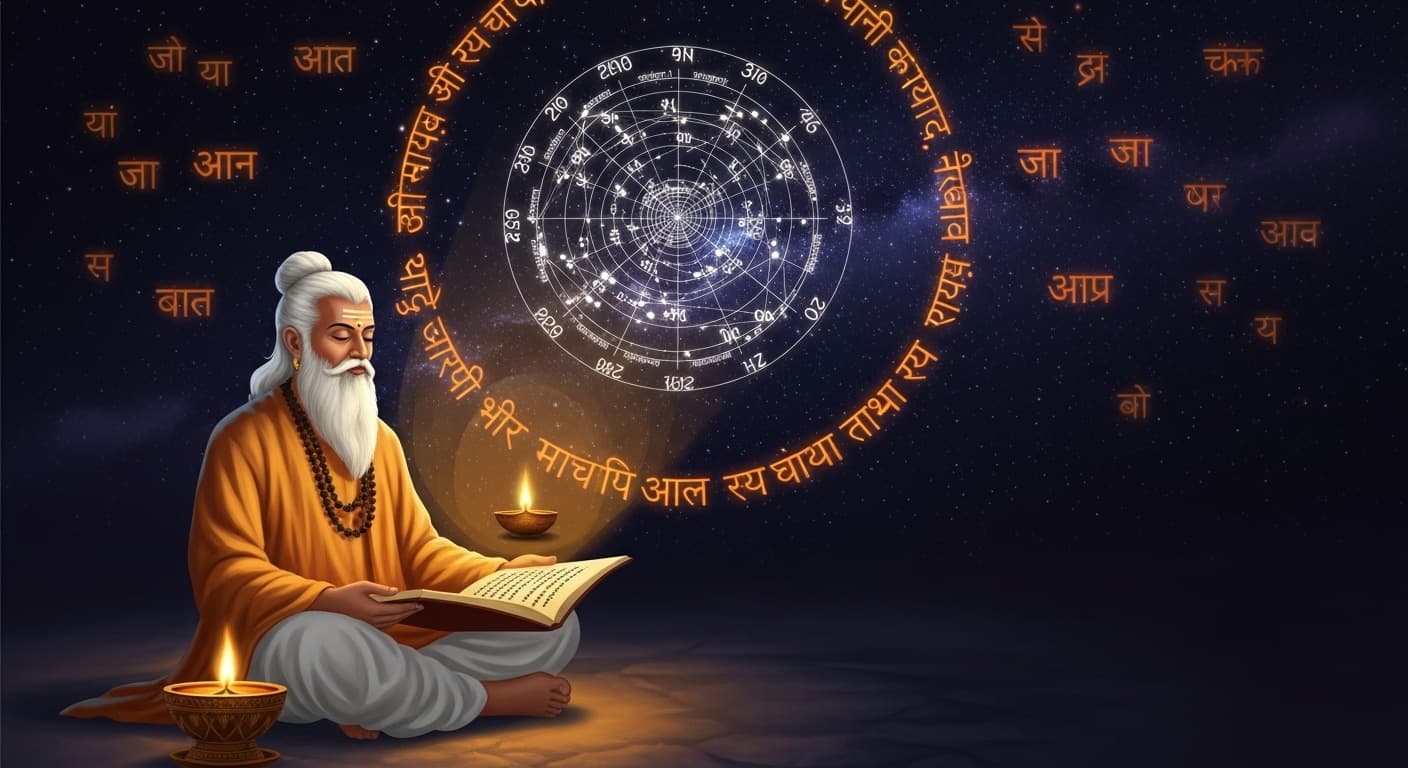
Vedic astrology, known in Sanskrit as Jyotish Shastra (the “science of light”), is one of the oldest and most comprehensive astrological systems in human history. Rooted in the sacred texts of ancient India — the Vedas — it is a sophisticated framework for understanding the influence of celestial bodies on human life, destiny, and consciousness.
Unlike casual sun-sign horoscopes found in newspapers, Vedic astrology is a deeply mathematical and astronomical discipline. It maps the precise positions of planets at the exact moment and location of your birth to construct a detailed birth chart, called a Kundli or Janam Patrika. This chart serves as a celestial blueprint of your life — revealing your personality, strengths, challenges, career trajectory, relationship patterns, health tendencies, and the timing of major life events.
What sets Vedic astrology apart from other systems is its use of the sidereal zodiac, its remarkably precise timing techniques (such as the Dasha system), and its integration of remedial measures — mantras, gemstones, and rituals — to help individuals navigate challenging planetary periods. For a detailed comparison with the tropical system used in the West, see our guide on Vedic vs Western astrology.
Origins and History of Vedic Astrology
The origins of Jyotish stretch back over 5,000 years to the Vedic period of ancient India. Jyotish is considered one of the six Vedangas (limbs of the Vedas) — auxiliary disciplines essential for understanding and applying Vedic knowledge. Its primary purpose was to determine the correct timing for Vedic rituals and sacrifices, but it evolved over millennia into a comprehensive system for understanding individual karma and destiny.
The foundational text of Vedic astrology as practiced today is the Brihat Parashara Hora Shastra (BPHS), attributed to the great sage Maharishi Parashara. Parashara is believed to have lived around 3,000 BCE and is credited with systematizing the principles of Jyotish into a coherent framework. The BPHS covers everything from planetary characteristics and house significations to planetary periods, yogas, and remedial measures. It remains the definitive reference for the Parashari system, which is the most widely practiced school of Vedic astrology in India and around the world.
Other important historical texts include the Brihat Jataka by Varahamihira (6th century CE), Jataka Parijata, Phaladeepika, and Saravali. Together, these works form a vast library of astrological knowledge that has been continuously studied, practiced, and refined for thousands of years.
The word “Jyotish” itself comes from jyoti (light) and isha (lord or master), meaning “the lord of light” or “the science of light.” This name reflects the fundamental belief that the luminous celestial bodies — the Sun, Moon, planets, and stars — are not random objects, but carriers of cosmic intelligence that illuminate the path of every living being.
Jyotish is also intimately connected with Vedic remedial practice. The Navagraha Stotra (nine-planet hymns), Beej Mantras for each planet (such as Om Hraam Hreem Hraum Sah Suryaya Namaha for the Sun), and planetary Yantras (sacred geometric diagrams like the Surya Yantra or Shani Yantra) are all integral parts of applied Vedic astrology. This integration of cosmic observation with practical remediation is what sets Jyotish apart from purely predictive systems and gives it its enduring relevance as a living spiritual tradition.
Core Components of Vedic Astrology
Vedic astrology is built on four interconnected pillars: the Rashis (zodiac signs), Bhavas (houses), Navagraha (planets), and Nakshatras (lunar mansions). Understanding these components is essential for reading any birth chart.
The 12 Rashis (Zodiac Signs) and the Sidereal Zodiac
Like Western astrology, Vedic astrology divides the zodiac into 12 signs (Rashis), each spanning 30 degrees. The twelve Rashis are: Mesha (Aries), Vrishabha (Taurus), Mithuna (Gemini), Karka (Cancer), Simha (Leo), Kanya (Virgo), Tula (Libra), Vrishchika (Scorpio), Dhanu (Sagittarius), Makara (Capricorn), Kumbha (Aquarius), and Meena (Pisces).
The critical difference lies in the zodiac system used. Vedic astrology employs the sidereal zodiac (Nirayana), which is tied to the actual observable positions of the fixed stars. Western astrology uses the tropical zodiac (Sayana), which is fixed to the seasons and the vernal equinox. Due to the precession of the equinoxes — a slow wobble in Earth's axis — the two zodiacs have diverged by approximately 24 degrees. This means your Vedic sun sign may be different from your Western sun sign, and this is one reason why Vedic predictions often differ from Western horoscopes.
The 12 Bhavas (Houses)
The birth chart is divided into 12 houses (Bhavas), each governing a specific domain of life. The Ascendant (Lagna) — the sign rising on the eastern horizon at the moment of birth — determines the 1st house, and the remaining houses follow sequentially.
- 1st House (Lagna): Self, personality, physical body, overall life direction
- 2nd House: Wealth, family, speech, early education, food preferences
- 3rd House: Courage, siblings, communication, short journeys, skills
- 4th House: Mother, home, property, vehicles, emotional well-being
- 5th House: Intelligence, children, creativity, romance, past-life merit (Purva Punya)
- 6th House: Enemies, disease, debts, daily work, service, legal disputes
- 7th House: Marriage, partnerships, spouse, business relationships
- 8th House: Longevity, transformation, occult knowledge, inheritance, sudden events
- 9th House: Fortune, father, dharma, higher education, long-distance travel, guru
- 10th House: Career, profession, reputation, authority, public life
- 11th House: Gains, income, friendships, aspirations, elder siblings
- 12th House: Losses, expenses, foreign lands, liberation (Moksha), sleep, isolation
The interplay between planets, signs, and houses is what gives Vedic astrology its extraordinary depth. A planet's effect changes dramatically depending on which house it occupies, which house it rules, and which planets it aspects or conjoins.
The 9 Navagraha (Planets)
Vedic astrology works with nine celestial bodies, collectively called the Navagraha:
- Surya (Sun): Soul, authority, father, government, vitality
- Chandra (Moon): Mind, emotions, mother, public, nourishment
- Mangal (Mars): Energy, courage, siblings, property, conflict
- Budha (Mercury): Intellect, communication, commerce, logic, learning
- Guru (Jupiter): Wisdom, expansion, children, wealth, spirituality
- Shukra (Venus): Love, beauty, luxury, marriage, artistic pursuits
- Shani (Saturn): Discipline, karma, delays, longevity, hard work
- Rahu (North Lunar Node): Ambition, obsession, foreign influences, unconventional paths
- Ketu (South Lunar Node): Spirituality, detachment, past-life karma, mysticism
Rahu and Ketu are shadow planets (Chaya Grahas) — mathematical points where the Moon's orbital plane intersects the ecliptic. Despite lacking physical bodies, they are considered tremendously powerful in Vedic astrology, governing karmic patterns, obsessions, and spiritual evolution. Their placement in a chart often reveals the soul's deepest desires and the lessons it needs to learn in this lifetime.
The 27 Nakshatras (Lunar Mansions)
One of the most distinctive features of Vedic astrology is its system of 27 Nakshatras — lunar mansions that divide the 360-degree zodiac into segments of 13 degrees and 20 minutes each. While the Rashis provide a broad framework, the Nakshatras add extraordinary precision and nuance.
Each Nakshatra has its own ruling deity, planetary lord, animal symbol, and unique characteristics. For example, Ashwini Nakshatra (ruled by Ketu) is associated with healing and swift action, while Rohini (ruled by the Moon) is linked to creativity, beauty, and material abundance. The Nakshatra of your Moon at birth — your Janma Nakshatra — is considered even more important than your Moon sign in many traditional applications, including naming ceremonies, marriage compatibility (Ashtakoota matching), and the calculation of your Dasha periods.
Key Concepts in Vedic Astrology
The Birth Chart (Kundli / Janam Patrika)
The birth chart, or Kundli, is the cornerstone of Vedic astrology. It is a map of the sky at the exact moment and location of your birth, showing the positions of all nine planets across the 12 houses and signs. Creating an accurate Kundli requires three precise inputs: your date of birth, time of birth, and place of birth.
The Kundli is typically represented in either the North Indian (diamond) or South Indian (square grid) chart format. Regardless of the format, the information is the same — it shows your Ascendant (Lagna), the placement of each planet, and the signs occupying each house. If you are curious about interpreting your own chart, our guide on how to read a birth chart walks you through the process step by step.
Divisional Charts (Varga Charts)
Beyond the main birth chart (called the D1 or Rashi chart), Vedic astrology uses a system of divisional charts — sub-charts derived by mathematically dividing each sign into smaller segments. Parashara described 16 primary divisional charts (Shodasha Varga), though the most commonly used are:
- D9 (Navamsa): The most important divisional chart after D1. It reveals the deeper nature of a person, the quality of marriage, the strength of planets, and is often called the “chart of destiny.” No serious Vedic astrologer reads a chart without consulting the Navamsa.
- D10 (Dasamsa): Dedicated to career and professional life. It shows your career trajectory, reputation in the professional world, and the nature of your work.
- D2 (Hora): Related to wealth and financial prosperity.
- D7 (Saptamsa): Related to children and progeny.
- D12 (Dwadasamsa): Related to parents and lineage.
Divisional charts allow astrologers to zoom into specific life areas with remarkable precision. A planet may appear strong in the D1 chart but weak in the D9, which significantly modifies its results — especially in the area of relationships and marriage.
Planetary Strength (Shadbala)
Not all planets are equally powerful in a chart. Vedic astrology quantifies planetary strength through a system called Shadbala (literally “six strengths”). This composite score evaluates each planet across six dimensions: positional strength (Sthana Bala), directional strength (Dig Bala), temporal strength (Kala Bala), motional strength (Chesta Bala), natural strength (Naisargika Bala), and aspectual strength (Drik Bala).
A planet with high Shadbala can deliver powerful positive results in the areas it governs, while a planet with low Shadbala may struggle to produce its significations effectively. Understanding Shadbala is crucial for making accurate predictions and is one of the reasons why computerized astrological analysis — which can calculate these values precisely — has become so valuable.
Yogas (Planetary Combinations)
Yogas are specific combinations of planets, signs, and houses that produce defined results in a person's life. The classical texts describe hundreds of yogas, ranging from highly auspicious to deeply challenging. Some of the most well-known include:
- Raj Yoga: A combination of Kendra (angular) and Trikona (trinal) lords that bestows power, authority, and success.
- Dhana Yoga: Wealth-producing combinations involving the lords of the 1st, 2nd, 5th, 9th, and 11th houses. To explore how these yogas appear in your chart, check out the Wealth & Billionaire Potential Report.
- Gaja Kesari Yoga: Formed when Jupiter is in a Kendra from the Moon, giving wisdom, fame, and prosperity.
- Mangal Dosha (Kuja Dosha): Mars in the 1st, 4th, 7th, 8th, or 12th house, which is carefully analyzed for marriage compatibility.
- Pancha Mahapurusha Yogas: Five exalted planetary positions (Hamsa, Malavya, Ruchaka, Bhadra, Sasa) that indicate extraordinary qualities.
A yoga's actual effect depends on the strength of the involved planets (Shadbala), their placement in divisional charts, and whether its results are activated during a relevant Dasha period. This layered analysis is what separates skilled Vedic interpretation from simplistic chart reading.
The Dasha System (Timing of Events)
Perhaps the most powerful and unique feature of Vedic astrology is the Dasha system — a method for predicting when specific events and themes will unfold in a person's life. While the birth chart shows potential, the Dasha system reveals timing.
The most widely used Dasha system is the Vimshottari Dasha, a 120-year cycle where each of the nine planets rules a specific period (Mahadasha) of varying length. For example, Venus Mahadasha lasts 20 years, while Sun Mahadasha lasts only 6 years. Each Mahadasha is further subdivided into sub-periods (Antardashas), sub-sub-periods (Pratyantardashas), and beyond — allowing astrologers to narrow down predictions to specific months or even weeks.
The Dasha sequence begins from the Nakshatra of the Moon at birth, which is why accurate birth time is so critical in Vedic astrology. During a particular planet's Dasha, the themes and houses governed by that planet come to the forefront of your life. For a deeper exploration of this timing mechanism, read our article on the Vimshottari Dasha system.
How Vedic Astrology is Used Today
Far from being a relic of the past, Vedic astrology is thriving in the modern world. Millions of people across India and the global diaspora consult Jyotish for major life decisions, and its popularity is growing rapidly among seekers worldwide. Here are some of the most common applications:
- Comprehensive Life Reports: Modern platforms like AstroPath generate detailed life guidance reports that analyze your complete birth chart — including divisional charts, Shadbala, yogas, and Dasha periods — to provide holistic insights across all areas of life.
- Marriage Matching (Kundli Milan): One of the most traditional applications. The Ashtakoota system compares the Moon Nakshatras of two individuals across eight compatibility categories, generating a score out of 36. Most families in India consider a score of 18 or above acceptable for marriage.
- Career and Financial Planning: Analysis of the 10th house (career), 2nd and 11th houses (wealth), and relevant Dashas helps individuals understand their optimal career path and identify favorable financial periods.
- Muhurta (Auspicious Timing): Selecting favorable dates and times for important activities — starting a business, buying property, getting married, or embarking on a journey.
- Remedial Measures: When challenging planetary periods are identified, Vedic astrology prescribes specific remedies — gemstone recommendations, mantra recitation, charitable acts, and rituals — to mitigate negative effects.
- Health Analysis: Medical astrology (Vaidya Jyotish) examines planetary indicators of health vulnerabilities, helping individuals take preventive measures during challenging health periods.
Technology has made Vedic astrology more accessible than ever. Accurate astronomical calculations that once required hours of manual computation can now be performed instantly. This has democratized access to high-quality astrological analysis, making it available to anyone with accurate birth details — not just those who can afford expensive personal consultations.
Getting Started with Vedic Astrology
If this guide has sparked your curiosity about Vedic astrology, the best way to begin is by exploring your own birth chart. You will need three things: your exact date of birth, your time of birth (as precise as possible — check your birth certificate), and your place of birth.
With these details, you can generate a comprehensive Vedic astrology report that analyzes your Ascendant, planetary placements, divisional charts, active Dasha periods, yogas, and much more. Rather than spending hours trying to decipher astrological tables on your own, a well-structured report translates the ancient wisdom of Jyotish into clear, actionable insights specific to your life.
Whether you want to understand your personality and karmic patterns, identify upcoming favorable periods, gain clarity on career decisions, or explore your relationship potential, your birth chart holds the answers. The ancient rishis encoded this knowledge in the language of the stars — all you need to do is learn to read it.
