
Vedic Astrology
Horoscope & Rashifal
Discover your Vedic zodiac sign profile. Each sign carries unique qualities shaped by its ruling planet, element, and modality according to Jyotish tradition.
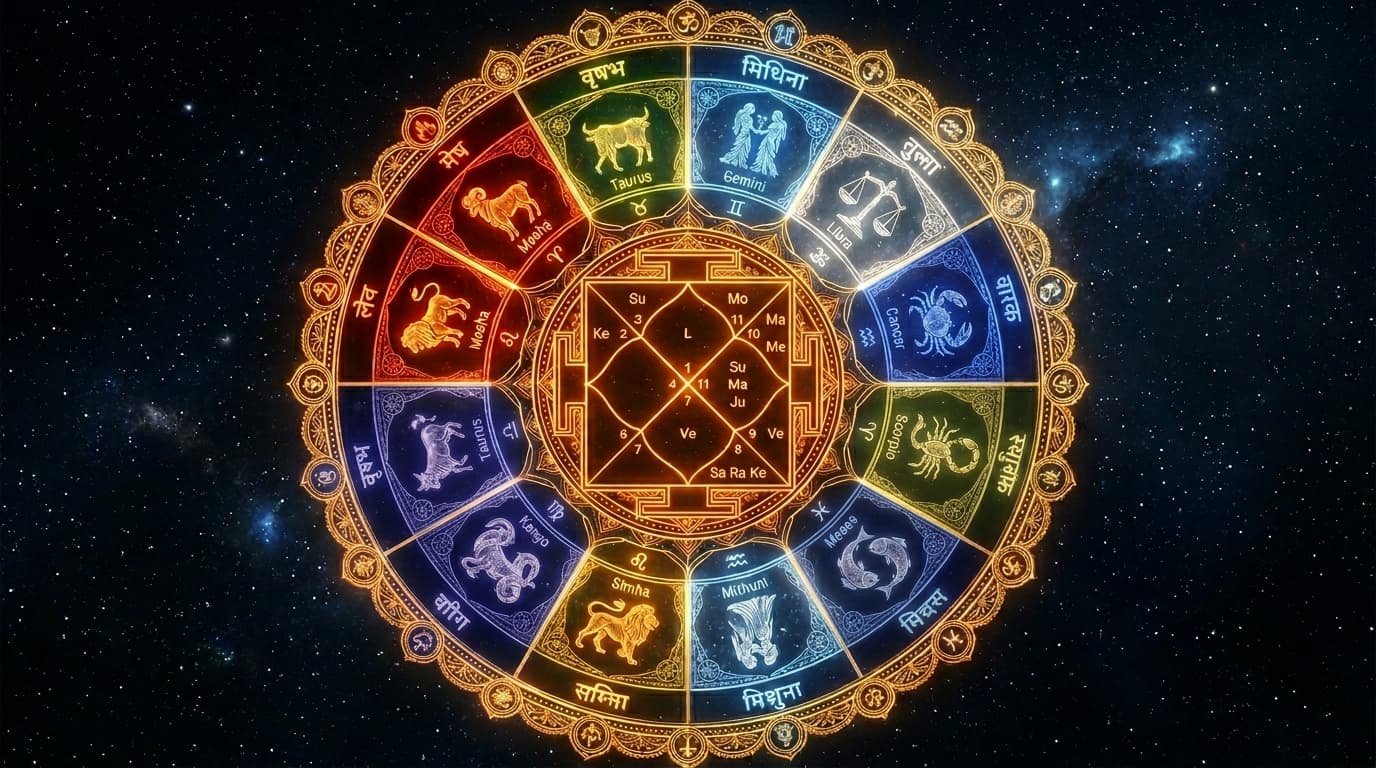
Aries
Mesha Rashifal
Mar 21 - Apr 19
Ruler: Mars · Fire
Taurus
Vrishabha Rashifal
Apr 20 - May 20
Ruler: Venus · Earth
Gemini
Mithuna Rashifal
May 21 - Jun 20
Ruler: Mercury · Air
Cancer
Karka Rashifal
Jun 21 - Jul 22
Ruler: Moon · Water
Leo
Simha Rashifal
Jul 23 - Aug 22
Ruler: Sun · Fire
Virgo
Kanya Rashifal
Aug 23 - Sep 22
Ruler: Mercury · Earth
Libra
Tula Rashifal
Sep 23 - Oct 22
Ruler: Venus · Air
Scorpio
Vrishchika Rashifal
Oct 23 - Nov 21
Ruler: Mars · Water
Sagittarius
Dhanu Rashifal
Nov 22 - Dec 21
Ruler: Jupiter · Fire
Capricorn
Makara Rashifal
Dec 22 - Jan 19
Ruler: Saturn · Earth
Aquarius
Kumbha Rashifal
Jan 20 - Feb 18
Ruler: Saturn · Air
Pisces
Meena Rashifal
Feb 19 - Mar 20
Ruler: Jupiter · Water
Get a personalised Vedic birth chart analysis
Generate Your Free ReportWhat Are the 12 Rashis?
The Rashis are the twelve 30° sectors of the zodiac in Vedic astrology. Each Rashi is ruled by a planet, governs one of the four elements (Tattvas), and carries a distinct quality (Guna) — cardinal (Chara), fixed (Sthira), or mutable (Dwiswabhava). When astrologers refer to “your Rashi,” they almost always mean your Janma Rashi — the sign occupied by the Moon at the moment of your birth.
In Jyotish, the Moon represents the mind, emotions, and the ever-changing inner landscape, which is why Vedic horoscopes weight the Moon sign far more heavily than the Sun sign. The 30° sector containing your natal Moon defines how you experience your inner world, react under pressure, and form lasting bonds.
The system uses the sidereal zodiac — measured against the fixed stars — rather than the tropical zodiac used in Western astrology. This is why your Vedic Rashi often differs by one sign from your Western Sun sign, and why a real Vedic horoscope analysis cannot simply be translated from a Western reading.
Moon Sign vs Sun Sign — Which One Is Your “Real” Rashi?
In daily Indian usage, “Rashi” almost always means the Moon sign — the sign occupied by the Moon at your birth. This is the sign used for daily Rashifal predictions, Sade Sati analysis, and Kundli matching for marriage.
Western astrology popularised the Sun sign — the sign occupied by the Sun at birth — as the primary identifier. Sun sign content (the kind you see in newspaper horoscopes) is widely available, but Vedic astrology treats the Sun sign as secondary because the Sun changes signs only once a month, while the Moon shifts every 2.25 days, capturing the much finer texture of an individual's emotional life.
If you don't know your Moon sign, the free rising sign calculator or birth chart calculator computes it from your birth time and place. Once you know it, the daily horoscope you read should be your Moon sign's, not your Sun sign's, for predictions to actually feel relevant.
The Four Elements (Tattvas)
Fire (Agni): Aries, Leo, Sagittarius. Energy, courage, vision, leadership. These signs initiate action, take risks, and sustain long-term ambition. Underdeveloped Fire shows as restlessness or burnout.
Earth (Prithvi): Taurus, Virgo, Capricorn. Practicality, patience, material discipline. These signs build slowly, value stability, and excel at structure. Excess Earth becomes rigidity or attachment to security.
Air (Vayu): Gemini, Libra, Aquarius. Intellect, communication, social connection. These signs think in ideas, connect across networks, and thrive on dialogue. Imbalanced Air becomes scattered or detached from feeling.
Water (Jala): Cancer, Scorpio, Pisces. Emotion, intuition, depth. These signs feel before they think, hold lasting memory, and form profound bonds. Excess Water can mean emotional flooding or escapism.
A balanced birth chart usually has all four elements represented across natal placements. Strong dominance or absence of any one element is one of the first things a Vedic astrologer reads from the chart.
Frequently Asked Questions
What is my Rashi?
Your Rashi is the zodiac sign occupied by the Moon at the moment of your birth, calculated using the sidereal zodiac. It is not the same as your Western Sun sign, which is often one sign earlier. Use a Vedic Kundli calculator with your exact birth time, date, and place to find your Janma Rashi accurately.
Is the Vedic horoscope different from a Western horoscope?
Yes. Vedic horoscopes use the sidereal zodiac (measured against fixed stars) and emphasize the Moon sign, while Western astrology uses the tropical zodiac and emphasizes the Sun sign. The two systems can give very different results — your Vedic and Western signs typically differ by one sign because of the ~24° Ayanamsa offset between the two zodiacs.
How accurate are daily horoscopes?
Daily Rashifal based on the Moon's transit through the 12 Rashis gives a real, measurable signal — but it is a generic forecast based on Moon sign alone. For meaningful prediction, a full birth chart analysis using house lordships, dasha periods, and planetary aspects is required. Daily horoscopes are best read as broad mood guidance, not literal forecasts.
Should I read my Sun sign or Moon sign horoscope?
For Vedic horoscopes, always read your Moon sign. The daily Rashifal, weekly forecast, and yearly predictions on this site are calibrated to the Moon sign. If you also want a Sun sign reading for general life direction, that is a complementary lens — but the primary Rashi in Jyotish is always the Moon sign.