
How to Read Your Vedic Birth Chart (Kundli): Step-by-Step Guide
Quick Answer: Reading a Vedic birth chart (Kundli) starts with identifying the Ascendant (Lagna) — the rising sign at birth — which anchors the entire 12-house framework. Each house then governs a specific domain of life, while each planet's sign, house placement, dignity, and aspects reveal how its significations will manifest. Predictive accuracy requires layering house analysis with divisional charts and Vimshottari Dasha timing.
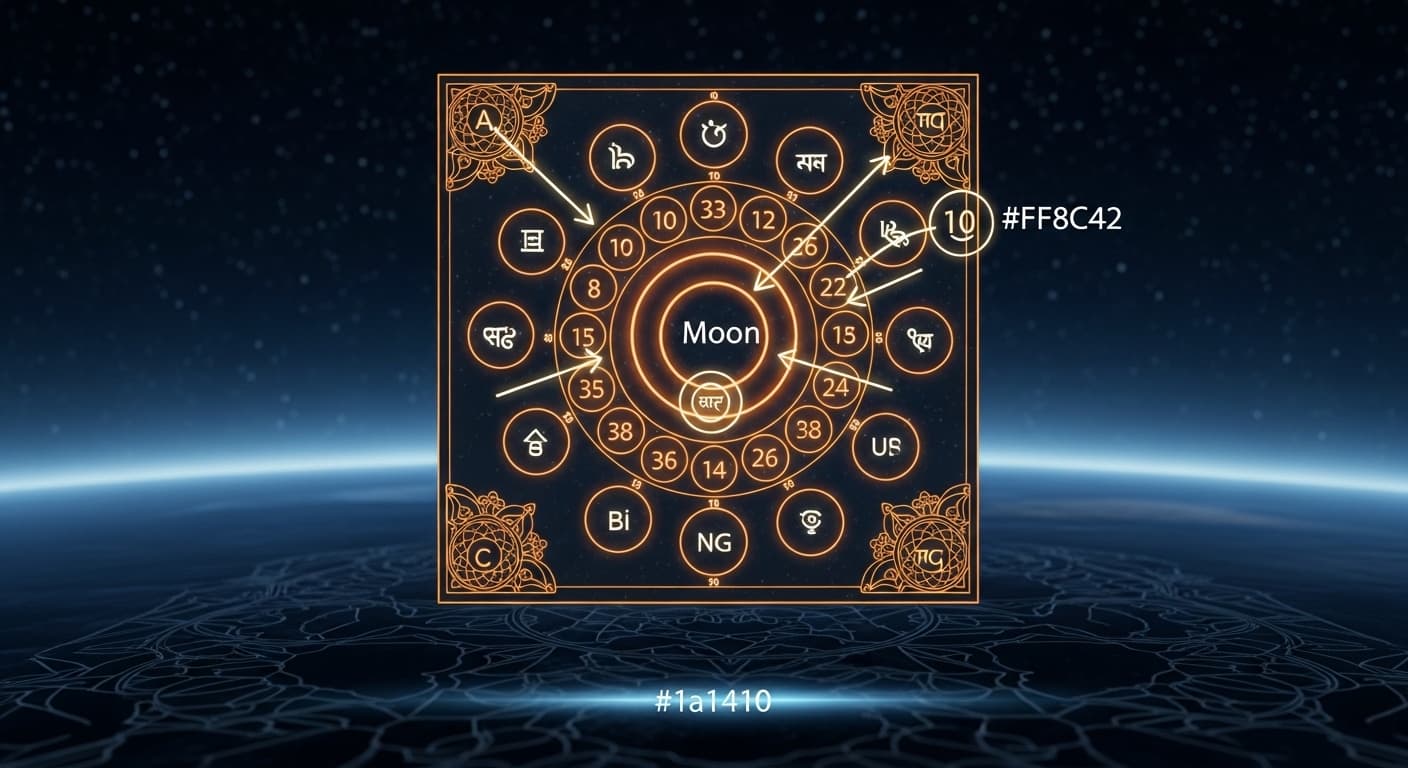
A Vedic birth chart, known as Kundli or Janam Patri, is one of the most powerful tools in Vedic astrology (Jyotish Shastra) . It is essentially a cosmic snapshot — a precise map of the sky at the exact moment you were born. Every planet, every sign, every house in this map carries meaning about your personality, destiny, relationships, career, and spiritual path.
If you have ever looked at a Kundli and felt overwhelmed by the numbers, symbols, and grids, you are not alone. But reading a birth chart is not as difficult as it appears. Once you understand the building blocks — the 12 houses, the 9 planets, and the 12 signs — the chart starts telling a story. This guide walks you through every step, from understanding the chart format to interpreting planetary placements, aspects, and yogas.
What is a Birth Chart (Kundli)?
A birth chart is a two-dimensional representation of the sky as seen from your birthplace at the exact time of your birth. Imagine standing at the spot where you were born and looking up at the sky: the positions of the Sun, Moon, Mars, Mercury, Jupiter, Venus, Saturn, Rahu, and Ketu at that precise moment are frozen and mapped into a diagram divided into 12 sections called houses (Bhavas).
Each house represents a specific area of life — from your physical appearance and personality (1st house) to your career and public reputation (10th house) to spirituality and liberation (12th house). The zodiac sign occupying each house and the planets placed within them determine how those areas of your life will unfold.
In Vedic astrology, the birth chart is not just a personality tool. It is a karmic blueprint — a record of the accumulated karma from past lives and a roadmap for the lessons, challenges, and opportunities of this lifetime. Vedic astrologers use it to predict timing of events through the Dasha system (planetary periods based on Nakshatras), identify strengths through Yogas (special combinations), and prescribe remedies to mitigate difficulties.
What You Need to Create a Birth Chart
To generate an accurate Vedic birth chart, you need three pieces of information:
1. Date of Birth
The calendar date determines the positions of slower-moving planets like Saturn, Jupiter, and the lunar nodes (Rahu and Ketu). These positions change over days, weeks, or months.
2. Exact Time of Birth
This is the most critical input. The Ascendant (Lagna) — the rising sign on the eastern horizon — changes roughly every two hours. But even a difference of 2 minutes can shift house cusps, alter divisional charts (like the Navamsa D9), and change the Dasha balance at birth. If your birth time is off by just a few minutes, predictions about career timing, marriage, and health can be inaccurate. Always try to obtain the most precise birth time possible, ideally from a hospital birth certificate.
3. Place of Birth
The geographic coordinates (latitude and longitude) of your birthplace determine which part of the sky was visible and, most importantly, which sign was rising. Two people born at the same time but in different cities will have different Ascendants and therefore very different charts.
The Two Chart Styles
Vedic astrology uses two primary chart formats. The information in both is identical — only the visual layout differs. Whichever format you encounter, the same 12 houses, same planets, and same signs apply.
North Indian Chart (Diamond Format)
The North Indian chart looks like a diamond rotated 45 degrees, divided into 12 triangular sections. The key feature of this format is that the houses are fixed in position. The 1st house (Ascendant) is always the top-center diamond, the 2nd house is to its left, and so on in a counter-clockwise direction. The zodiac signs rotate based on the individual's Ascendant. This format is popular in North India, including Delhi, Uttar Pradesh, Punjab, and surrounding regions.
South Indian Chart (Square Format)
The South Indian chart is a square grid divided into 12 boxes (3 outer boxes on each side, with a blank center). In this format, the signs are fixed in position — Pisces is always in the top-left box, Aries in the second box of the top row, and so on clockwise. The houses rotate based on the Ascendant sign. This format is used predominantly in South India — Tamil Nadu, Karnataka, Kerala, and Andhra Pradesh. Many astrologers consider this format easier to read because the zodiac signs never move, making it simpler to spot planetary transits at a glance.
Understanding the 12 Houses (Bhavas)
The 12 houses are the foundation of chart interpretation. Each house governs specific areas of life. When a planet sits in a house, it influences those life areas with its energy. An empty house is not “bad” — it simply means those areas are primarily influenced by the house lord (the planet that rules the sign occupying that house) rather than by a direct planetary presence.
Self, personality, physical body, overall vitality, and first impression. This is the most important house — the lens through which the entire chart is interpreted. The sign and planets here shape your temperament, appearance, and approach to life.
Wealth, family, speech, food habits, and early education. This house reveals your earning capacity, relationship with family, and the quality of your voice and communication style. It is a key house for Dhana Yoga analysis.
Courage, younger siblings, short travels, communication skills, writing, and self-effort. A strong 3rd house gives determination and the ability to take initiative. It also governs hobbies and artistic pursuits.
Mother, home, domestic happiness, land, property, vehicles, and formal education. This house reflects your emotional foundation, inner peace, and comfort in life. It also indicates your relationship with your mother.
Children, creativity, romance, intelligence, speculation, and past-life merit (Purva Punya). This is the house of joy and creative expression. It governs love affairs (before marriage), gambling, stock markets, and your relationship with children.
Enemies, diseases, debts, legal disputes, daily work routine, and service. While considered a “difficult” house, a strong 6th house gives the ability to defeat competitors, overcome illness, and clear debts. It is important for medical and legal professionals.
Marriage, spouse, partnerships, business associates, and public dealings. This house describes the nature of your spouse, the quality of your married life, and your ability to form meaningful partnerships in business and life.
Longevity, hidden matters, sudden events, inheritance, insurance, research, occult knowledge, and transformation. This house governs everything that is hidden beneath the surface — secrets, mysteries, and deep psychological patterns.
Fortune, luck, father, religion, philosophy, higher education, long-distance travel, and spiritual teachers (Guru). This is the most auspicious house, often called the house of Bhagya (luck). A strong 9th house indicates a fortunate life supported by dharma.
Career, profession, public image, authority, reputation, and life purpose. This is the highest point of the chart and represents your most visible achievements. Read our detailed guide on the 10th house and career astrology.
Gains, income, fulfillment of desires, elder siblings, social networks, and large organizations. This is the house of achievement — it shows how and where you will gain materially and socially. It is a key house in wealth analysis.
Losses, expenses, foreign travel, foreign settlement, isolation, hospitalization, spirituality, and Moksha (liberation). Though feared by many, this house governs the deepest spiritual experiences. A well-placed 12th house can indicate life abroad, spiritual enlightenment, or success in careers related to foreign countries.
The 9 Planets (Navagraha)
In Vedic astrology, nine celestial bodies are considered “planets” (Grahas). This includes the Sun and Moon (luminaries), five visible planets (Mars, Mercury, Jupiter, Venus, Saturn), and two shadow planets or lunar nodes (Rahu and Ketu). Each Graha carries a distinct energy and governs specific aspects of life.
Sun (Surya) — The Soul
The Sun represents the Atma (soul), authority, government, father, vitality, ego, and leadership. A strong Sun gives confidence, recognition, and good health. It rules Leo and is exalted in Aries. The Sun spends about one month in each sign. In career astrology, it indicates government jobs, politics, and positions of power.
Moon (Chandra) — The Mind
The Moon governs the Mana (mind), emotions, mother, mental health, public image, and nurturing instincts. In Vedic astrology, the Moon sign (Rashi) is often considered more important than the Sun sign. It rules Cancer and is exalted in Taurus. The Moon changes signs roughly every 2.5 days, which is why birth time accuracy is so important.
Mars (Mangal) — Energy & Courage
Mars represents energy, courage, aggression, younger siblings, land, property, and physical strength. It rules Aries and Scorpio and is exalted in Capricorn. Mars in certain houses creates Mangal Dosh (Manglik Dosha), which has significant implications for marriage compatibility. It is a key planet for surgeons, military professionals, athletes, and engineers.
Mercury (Budha) — Intelligence & Communication
Mercury governs intellect, analytical ability, communication, commerce, mathematics, and adaptability. It rules Gemini and Virgo and is exalted in Virgo. A strong Mercury is essential for writers, accountants, traders, software developers, and anyone in communication or media industries. Mercury is the prince among planets — youthful, curious, and versatile.
Jupiter (Guru/Brihaspati) — Wisdom & Expansion
Jupiter is the great benefic — the planet of wisdom, expansion, luck, dharma, higher education, and children. It rules Sagittarius and Pisces and is exalted in Cancer. Jupiter's placement and aspects can elevate the entire chart. It is the Karaka (significator) for wealth, children, and spiritual knowledge. Jupiter forms many important Dhana Yogas when connected with wealth houses.
Venus (Shukra) — Love & Luxury
Venus represents love, beauty, luxury, art, romance, marriage (for males), vehicles, and comforts. It rules Taurus and Libra and is exalted in Pisces. Venus is the Karaka for marriage and sensual pleasures. A well-placed Venus gives artistic talent, a beautiful spouse, financial comfort, and an appreciation for the finer things in life. It is crucial in wealth analysis.
Saturn (Shani) — Discipline & Karma
Saturn is the great teacher — the planet of discipline, hard work, karma, longevity, delays, and justice. It rules Capricorn and Aquarius and is exalted in Libra. Saturn rewards patience and punishes shortcuts. Its transits, especially Sade Sati (7.5 year Saturn transit over the Moon) and Dhaiya, are among the most discussed periods in Vedic astrology. Despite its fearsome reputation, Saturn ultimately builds character and lasting success.
Rahu — Obsession & the Unconventional
Rahu is the north lunar node — a shadow planet with no physical form. It represents obsession, ambition, foreign connections, unconventional paths, technology, and illusion. Rahu amplifies whatever it touches, creating intense desire in that area of life. It is associated with foreign travel, immigration, technology careers, and breaking social norms. Rahu is exalted in Taurus or Gemini (debated among scholars).
Ketu — Spirituality & Detachment
Ketu is the south lunar node — the counterpart of Rahu. It represents spirituality, detachment, past-life karma, moksha (liberation), and non-material pursuits. Ketu gives mastery in whatever house it occupies but also creates a sense of dissatisfaction with the material aspects of that house. It is associated with healers, monks, researchers, and those drawn to the metaphysical. Ketu is exalted in Scorpio or Sagittarius (debated).
Reading Your Chart: Step by Step
Now that you understand the houses and planets, here is a practical, step-by-step approach to reading any Vedic birth chart. Whether you are looking at your own chart or someone else's, follow these five steps in order.
Step 1: Identify Your Ascendant (Lagna)
The Ascendant is the zodiac sign that was rising on the eastern horizon at the time of your birth. It determines the numbering of all 12 houses. In the North Indian chart, look for the sign number written in the top-center diamond. In the South Indian chart, find where the Ascendant marker (usually “Asc” or “Lag”) is placed — that box becomes your 1st house. The Ascendant sign sets the tone for the entire chart. For example, an Aries Ascendant person approaches life with directness and initiative, while a Libra Ascendant person leads with diplomacy and partnership.
Step 2: Find Where Each Planet is Placed
Look at each of the 9 planets and note which house they occupy. Write it down: “Sun in the 10th house, Moon in the 4th house, Mars in the 7th house,” and so on. The house placement tells you where in life the planet's energy will manifest. For example, Venus in the 7th house strongly influences your marriage and partnerships, while Venus in the 2nd house affects wealth and family life. Also note the sign each planet is in. A planet in its own sign (like Mars in Aries) or exalted sign (like Jupiter in Cancer) is strong and gives positive results. A planet in its debilitated sign (like Saturn in Aries) struggles to express its best qualities.
Step 3: Note Which Houses Are Occupied and Which Are Empty
In most charts, only 5 to 7 houses will have planets. The remaining houses will be empty. An empty house does not mean that area of life will be blank or problematic. It simply means you need to look at the house lord — the planet that rules the sign occupying that house — and check where that lord is placed and how strong it is. For example, if your 7th house is empty but is occupied by Libra, you look at Venus (lord of Libra) — its house placement, sign placement, and aspects will tell the story of your marriage.
Step 4: Check Planetary Aspects
In Vedic astrology, every planet aspects (casts its influence on) the house directly opposite to it — the 7th house from its position. This is called the 7th aspect and is universal to all planets. However, three planets have special additional aspects:
- Mars has additional aspects on the 4th and 8th houses from its position.
- Jupiter has additional aspects on the 5th and 9th houses from its position.
- Saturn has additional aspects on the 3rd and 10th houses from its position.
Aspects are as powerful as direct placement. For instance, Jupiter aspecting the 5th house from any position blesses children and creativity, even if Jupiter is not physically placed in the 5th house. Saturn aspecting the 7th house can delay marriage or bring a mature, older spouse. Understanding aspects is essential because they expand a planet's influence beyond the single house it occupies.
Step 5: Look for Yogas (Planetary Combinations)
Yogas are specific combinations of planets, signs, and houses that produce amplified results — either very positive or very challenging. There are hundreds of yogas in classical Vedic texts, but here are some of the most important ones to look for in any chart:
- Raj Yoga: Formed when the lord of a Kendra house (1, 4, 7, 10) combines with the lord of a Trikona house (1, 5, 9). This yoga gives power, authority, and success. It is one of the most auspicious combinations in Vedic astrology.
- Dhana Yoga: Created when lords of wealth houses (2, 5, 9, 11) connect with each other or with Kendra lords. Read our detailed guide on Dhana Yoga and wealth combinations.
- Gajakesari Yoga: Jupiter in a Kendra (1, 4, 7, 10) from the Moon. Gives wisdom, fame, and financial success.
- Pancha Mahapurusha Yogas: Five yogas formed when Mars, Mercury, Jupiter, Venus, or Saturn are in their own or exalted sign and placed in a Kendra house. Each gives exceptional qualities — Ruchaka (Mars), Bhadra (Mercury), Hamsa (Jupiter), Malavya (Venus), and Sasa (Saturn).
- Viparita Raja Yoga: When lords of Dusthana houses (6, 8, 12) are placed in other Dusthana houses. Paradoxically, this yoga turns adversity into unexpected success and triumph.
Beyond the Basics: Planetary Strength and Divisional Charts
Once you are comfortable reading the basic birth chart (D1 or Rashi chart), there are two additional layers of analysis that professional Vedic astrologers always consider:
Shadbala (Six-fold Strength): This is a quantitative system that calculates a planet's total strength based on six different parameters — positional strength, directional strength, temporal strength, motional strength, natural strength, and aspectual strength. A planet with high Shadbala can deliver powerful results even from a seemingly weak house placement.
Divisional Charts (Vargas): The Rashi chart (D1) gives a broad overview, but divisional charts zoom into specific areas of life. The most important divisional chart is the Navamsa (D9), which reveals the deeper reality of the chart — especially marriage, dharma, and the true strength of planets. The Dashamsha (D10) focuses on career, and the Dreshkana (D3) reveals information about siblings and courage. Professional analysis always cross- references the D1 with relevant divisional charts for accurate predictions.
Next Steps: Get Your Professional Chart Analysis
Understanding your birth chart is a journey. The information above gives you the foundation to read any Vedic chart and identify the key patterns. However, the real depth of Vedic astrology lies in the interplay between all these elements — how planets modify each other through aspects and conjunctions, how Dasha periods activate different parts of the chart at different times, and how divisional charts confirm or modify the promises of the main chart.
If you want a thorough, personalized analysis of your birth chart — including Shadbala calculations, Yoga identification, Dasha timing predictions, and tailored remedies — our AI-powered Vedic astrology reports analyze your chart using classical Parashari principles with the depth and precision of an experienced astrologer.
Ready to Decode Your Birth Chart?
Get a comprehensive Vedic astrology report covering your personality, career path, wealth potential, relationships, health patterns, and timing of key life events.
