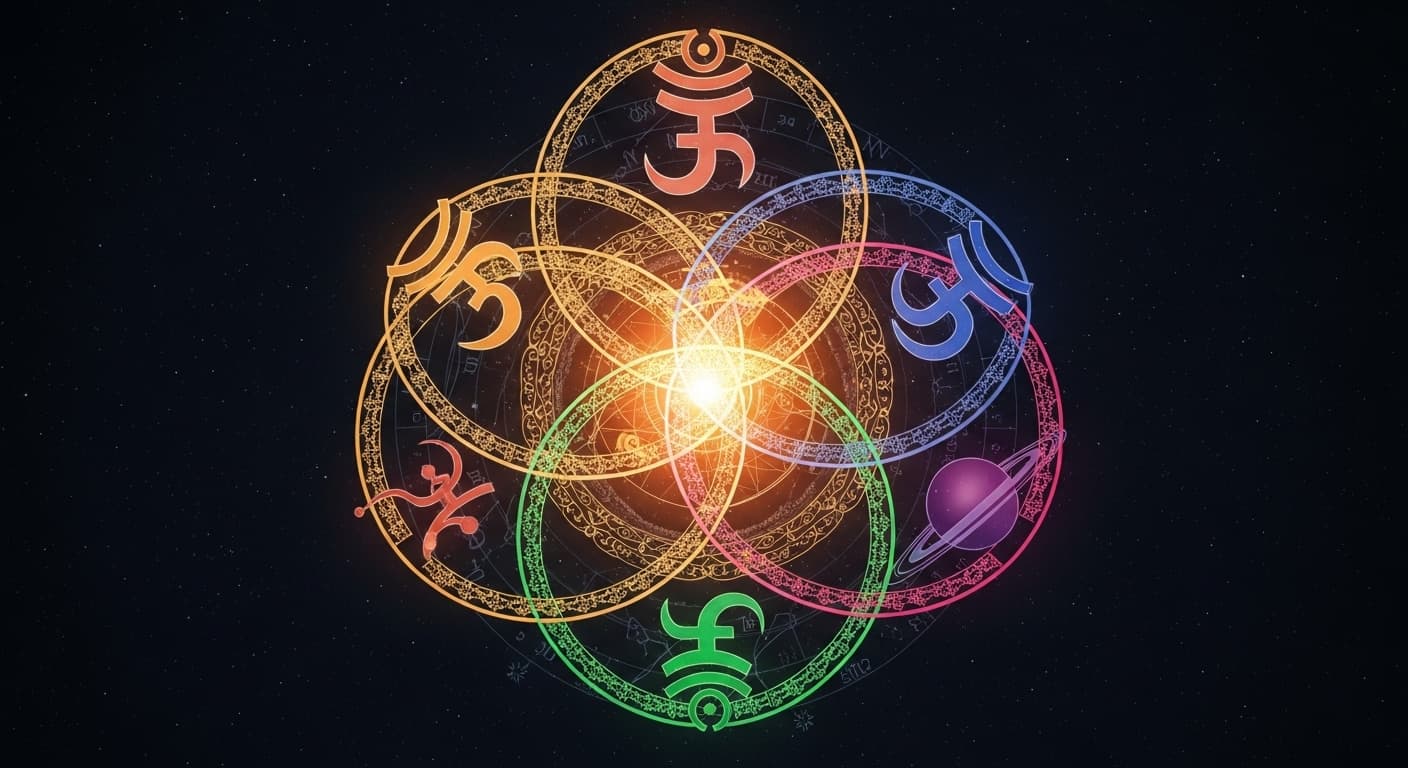
Vedic Yogas — planetary combinations glowing in a celestial mandala, representing Raja Yoga and Dhana Yoga configurations

What are Yogas in Vedic Astrology?

A Yoga in Vedic astrology is a specific planetary combination or configuration in the Kundli that produces a distinct result — positive or negative. The word "Yoga" means "union" or "combination," and hundreds of Yogas are described in classical texts like Brihat Parashara Hora Shastra and Phaladeepika.

Major Categories of Yogas

Raja Yogas are formed when lords of Kendra (angular) and Trikona (trinal) houses combine, indicating power, authority, and success. Dhana Yogas connect wealth houses (2nd, 5th, 9th, 11th) and promise financial prosperity. Pancha Mahapurusha Yogas occur when Mars, Mercury, Jupiter, Venus, or Saturn occupy their own or exaltation sign in an angular house — Ruchaka, Bhadra, Hamsa, Malavya, and Shasha respectively.

How Yogas Are Evaluated

A Yoga's potency depends on several factors: the strength of participating Grahas (via Shadbala), whether they are combust or retrograde, the aspects they receive, and the houses involved. A Raja Yoga formed by strong, unafflicted planets in angular houses delivers far more than one formed by weak planets in dusthana houses.

When Yogas Manifest

Having a Yoga in the birth chart is potential — its activation depends on timing. Yogas typically manifest during the Mahadasha or Antardasha of the participating planets, or when favorable transits trigger them. This is why Dasha analysis is inseparable from Yoga analysis.

Yogas in AstroPath Reports

Every AstroPath report identifies and evaluates the Yogas present in your chart, assessing their strength and mapping them to the Dasha timeline so you know when to expect their results.

Related Concepts

Read More — Yoga Guides

Common Questions

Frequently Asked Questions

What are Yogas in Vedic astrology?

Yogas are specific planetary combinations, house placements, and sign configurations in a birth chart that produce defined results. Classical Vedic texts describe hundreds of yogas, ranging from highly auspicious (Raja Yoga, Dhana Yoga, Gaja Kesari Yoga) to challenging (Daridra Yoga, Kemadruma Yoga). A yoga's actual effect depends on the strength of the planets involved, their placement in divisional charts, and whether they are activated by the Dasha system.

What are the most powerful yogas in Vedic astrology?

The most powerful auspicious yogas include: Raja Yoga (Kendra-Trikona lord combination giving power and authority), Pancha Mahapurusha Yoga (five great planetary positions in Kendra houses), Gaja Kesari Yoga (Jupiter in Kendra from Moon — wisdom and fame), Dhana Yoga (wealth combinations), and Hamsa Yoga (Jupiter in Sagittarius, Pisces, or Cancer in a Kendra). These yogas, when confirmed by the Navamsa chart, can produce extraordinary results.

How do you know if a yoga will activate in your life?

A yoga activates when: (1) the planets forming it are strong in the birth chart and Navamsa, (2) the Dasha or Antardasha of a planet forming the yoga is running, (3) supportive Jupiter or Saturn transits occur over the yoga planets, and (4) the yoga is confirmed in relevant divisional charts (Navamsa for personal results, Dasamsa for career results). Many people have yogas in their charts that never fully manifest because the conditions for activation are never met.

What is the difference between a yoga and a dosha?

A yoga is a auspicious planetary combination that produces positive results, while a dosha is a challenging combination or placement that creates obstacles or difficulties. Common doshas include Mangal Dosha (Mars in 1st, 4th, 7th, 8th, or 12th house — affecting marriage), Kaal Sarp Dosha (all planets between Rahu and Ketu — creating life struggles), and Pitru Dosha (affliction to the 9th house — ancestral karma). Doshas also require activation through Dasha periods to fully manifest.

How Yogas in Vedic Astrology: Planetary Combinations fits in classical Vedic astrology

The concept of Yogas in Vedic Astrology: Planetary Combinations belongs to the tradition of Parashari Jyotish, the school of Vedic astrology systematised by the sage Parashara in the Brihat Parashara Hora Shastra (BPHS) — the single most authoritative classical source in this tradition. BPHS defines planetary periods, divisional charts, house significations, yogas, and remedial measures across more than 100 chapters, and Yogas in Vedic Astrology: Planetary Combinations finds its classical grounding there. The wiki entry above is a quick reference: a concise summary of what Yogas in Vedic Astrology: Planetary Combinations is and how it is defined.

In practice, a full reading never treats Yogas in Vedic Astrology: Planetary Combinations as a standalone verdict. A Vedic astrologer evaluates it in the context of the complete birth chart — the Lagna (rising sign), the Moon sign, planetary strengths via Shadbala, the active Vimshottari Dasha period, and how transits from Saturn and Jupiter are currently interacting with the natal positions. This integration is what produces a reliable interpretation rather than a textbook recitation.

If you are researching Yogas in Vedic Astrology: Planetary Combinations in relation to your own chart, the entry above gives you the vocabulary and framework. The next step is to bring that understanding into a reading that accounts for every other planet and period in your chart — which is where a 1-on-1 consultation with a verified Vedic astrologer adds the most value.

Frequently asked questions

What is Yogas in Vedic Astrology: Planetary Combinations in Vedic astrology?

Yogas in Vedic Astrology: Planetary Combinations is one of the foundational concepts in classical Parashari Jyotish, the system of Vedic astrology codified in the Brihat Parashara Hora Shastra (BPHS). It refers to a specific principle — whether a planetary period, chart division, combination, or quality — that a Vedic astrologer evaluates as part of a complete chart reading. Unlike Western astrology, which reads planets against tropical zodiac positions, classical Vedic astrology positions every concept including Yogas in Vedic Astrology: Planetary Combinations against the sidereal zodiac using Lahiri ayanamsa. The wiki entry above offers a concise definition. A full reading contextualises Yogas in Vedic Astrology: Planetary Combinations against your Lagna, Moon sign, dasha timeline, and the strength of every relevant planet before drawing any conclusion.

How is Yogas in Vedic Astrology: Planetary Combinations interpreted in a birth chart reading?

Interpreting Yogas in Vedic Astrology: Planetary Combinations in a birth chart requires a layered approach. First, the astrologer identifies where the relevant planets, houses, or divisional charts associated with Yogas in Vedic Astrology: Planetary Combinations sit in the natal chart. Next, they evaluate the strength of those placements using Shadbala — the six-fold planetary strength system from classical Jyotish — which accounts for positional, directional, temporal, motional, natural, and aspectual strength simultaneously. Third, they time the activation of Yogas in Vedic Astrology: Planetary Combinations through the Vimshottari Dasha system: a concept may be present in the chart but only fully expressed during the Mahadasha or Antardasha of the planets most relevant to it. Transits (Gochar) of Saturn and Jupiter are then layered on top to pinpoint the specific window.

Are there classical sources that define Yogas in Vedic Astrology: Planetary Combinations?

Yes. The primary classical source for Yogas in Vedic Astrology: Planetary Combinations and virtually every concept in Parashari Vedic astrology is the Brihat Parashara Hora Shastra (BPHS), attributed to the sage Parashara. This text, running to over 100 chapters, defines house significations, planetary periods, divisional charts, yogas, and remedial measures in exhaustive detail. Varahamihira's Brihat Samhita and Phaladeepika (attributed to Mantreshwara) supplement BPHS with additional rules and commentary. Jaimini Sutras provide an alternative framework for specific chart elements. All of these are considered primary classical authorities and are cited by contemporary Vedic astrologers when interpreting Yogas in Vedic Astrology: Planetary Combinations.

How does Yogas in Vedic Astrology: Planetary Combinations interact with the rest of a Vedic chart?

No element in a Vedic chart operates in isolation, and Yogas in Vedic Astrology: Planetary Combinations is no exception. Its expression is modified by the strength of the ruling planet (evaluated via Shadbala), aspects from benefics (Jupiter, Venus, Mercury, waxing Moon) or malefics (Saturn, Mars, Rahu, Ketu), the condition of the relevant house lord, and the divisional chart picture — especially the D9 Navamsha, which either confirms or undermines what the main birth chart (D1) shows. Dashas time the activation: Yogas in Vedic Astrology: Planetary Combinations typically becomes prominent during the Mahadasha of the planet most closely associated with it. A skilled astrologer reads these layers together rather than treating Yogas in Vedic Astrology: Planetary Combinations as a standalone indicator.

Related guides

Vedic astrologer

Chat with a Vedic astrologer

₹0 first chat

Open App